
Fire protection systems are essential for protecting buildings, people, equipment, and business operations from fire-related risks. However, installing a fire alarm, fire pump, sprinkler, fire fighting, or emergency lighting system is only the beginning. These systems need regular inspection, testing, servicing, and maintenance to remain reliable when an emergency occurs.
Building owners and facility managers often choose between a Fire System Annual Maintenance Contract (AMC) and one-time maintenance services. While both options help maintain fire safety systems, they serve different purposes.
Understanding the difference can help you select the right maintenance approach for your building.
What Is a Fire System AMC?
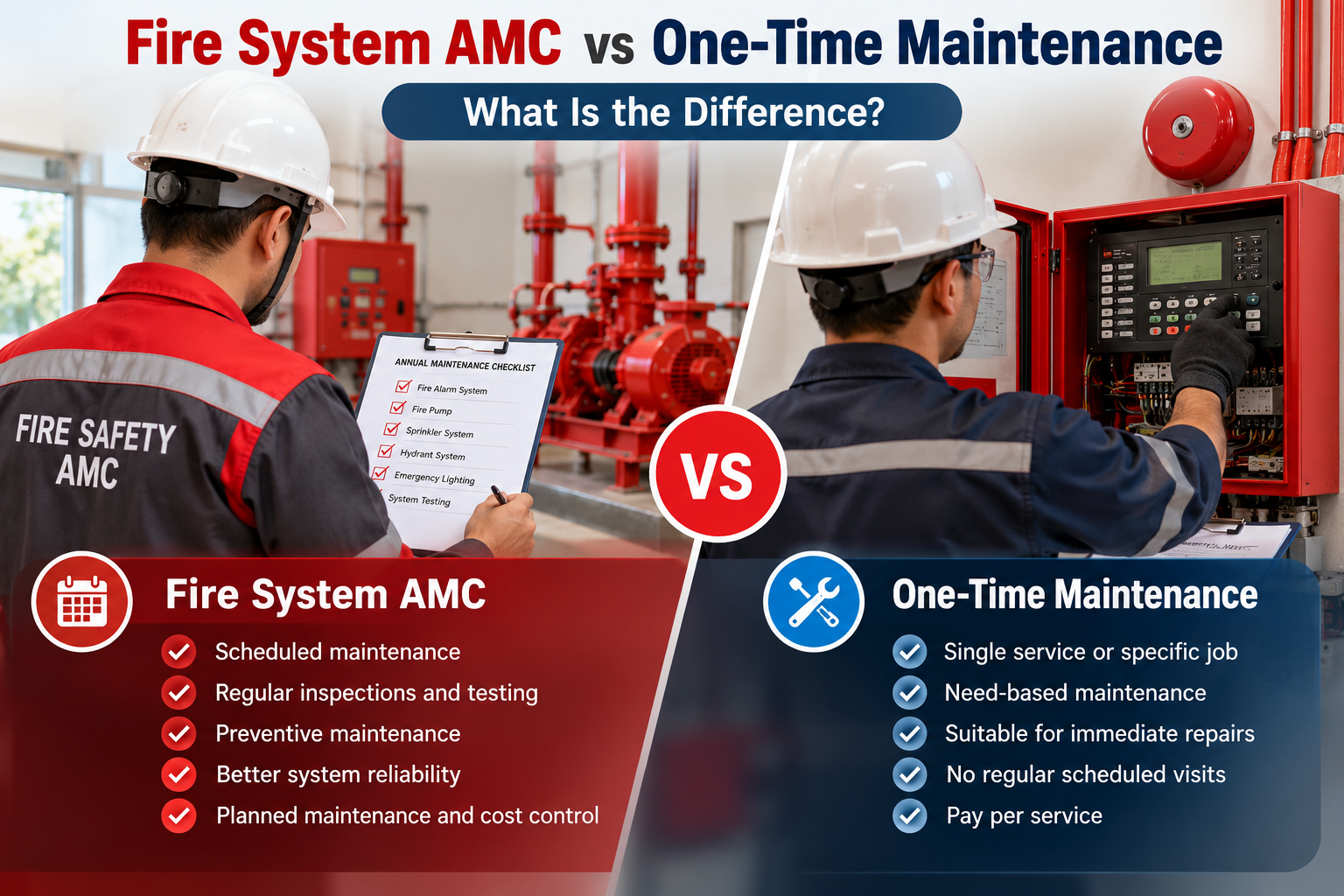
A Fire System AMC is an ongoing maintenance agreement between a building owner or facility manager and a fire safety service provider. The agreement usually covers a defined period, commonly one year, during which the service provider performs scheduled inspections, testing, preventive maintenance, and other agreed services.
Depending on the contract and the systems installed, an AMC may cover:
- Fire alarm systems
- Fire fighting systems
- Fire pumps
- Fire sprinkler systems
- Fire hydrant systems
- Emergency and exit lighting systems
- Fire extinguishers
- Control panels and detection devices
- Related fire safety equipment
The exact services included depend on the building, installed systems, maintenance requirements, and terms of the agreement.
The main purpose of an AMC is continuous preventive maintenance rather than fixing a problem only after it appears.
What Is One-Time Fire System Maintenance?
One-time maintenance is a service carried out for a specific maintenance requirement without entering into a long-term maintenance contract.
For example, a building may experience a problem with a fire pump, alarm panel, detector, sprinkler component, or emergency light. The owner can contact a fire safety company to inspect the issue and perform the required maintenance or repair.
One-time maintenance can also be useful when:
- A building needs a specific inspection
- A fire system has developed a fault
- Equipment requires immediate servicing
- A property owner wants maintenance before an inspection
- The building does not require a recurring service agreement
- A company wants to assess the condition of its existing fire systems before signing an AMC
In this model, maintenance is generally performed when a specific need arises or when the customer requests a service.
Fire System AMC vs One-Time Maintenance
The biggest difference is continuity.
| Feature | Fire System AMC | One-Time Maintenance |
| Service duration | Ongoing for the contract period | Single service or specific job |
| Maintenance approach | Preventive and scheduled | Usually need-based |
| Regular inspections | Included according to contract terms | Not automatically included |
| Long-term monitoring | Yes, based on agreement | No |
| Cost structure | Contract-based | Pay per service |
| Emergency support | May be included, depending on contract | Usually charged separately |
| Best suited for | Commercial buildings and facilities requiring regular maintenance | Specific repairs or occasional servicing |
The exact scope, response time, replacement parts, emergency support, and exclusions should always be confirmed in the service agreement.
Key Benefits of a Fire System AMC
1. Regular Preventive Maintenance
Fire protection equipment can deteriorate because of dust, environmental conditions, wear, electrical faults, corrosion, or component ageing. Regular maintenance helps identify potential problems before they become serious failures.
An AMC establishes a planned maintenance schedule rather than leaving maintenance until a fault occurs.
2. Better System Reliability
A fire alarm system or fire pump must work when required. Regular testing and servicing can help identify malfunctioning components, damaged connections, battery problems, pressure issues, and other concerns.
This improves the overall reliability of the fire protection system.
3. Easier Maintenance Planning
With an AMC, building managers can plan maintenance activities in advance. Scheduled inspections reduce the risk of forgetting important maintenance tasks.
This is particularly useful for commercial buildings, offices, warehouses, residential buildings, hotels, schools, and other properties with multiple fire protection systems.
4. Faster Response to Maintenance Issues
Some AMC agreements include defined response or support arrangements. This can make it easier for facility managers to contact the service provider when a problem occurs.
However, response times and emergency coverage vary between providers, so these terms should be clearly written into the contract.
5. Better Maintenance Records
Regular maintenance can create a documented history of inspections, testing, repairs, and replacements. These records can help facility managers understand the condition of their systems and plan future maintenance.
When Is One-Time Maintenance a Better Choice?
One-time maintenance can be practical when the requirement is limited or immediate.
For example, if a fire pump is not operating correctly, a building owner may need a specific inspection and repair rather than immediately entering into a yearly contract.
It can also be appropriate for smaller properties where the owner has limited maintenance requirements. However, the decision should consider the type of building, number of systems, operational risks, applicable requirements, and maintenance needs.
One-time maintenance should not be treated as a replacement for regular maintenance where continuous inspection and servicing are necessary.
Which Option Should You Choose?
The right choice depends on the building and its fire safety requirements.
A Fire System AMC is generally more suitable when a property has multiple fire protection systems that require scheduled inspection and maintenance throughout the year. It provides a structured approach to preventive maintenance.
One-time maintenance is more suitable when the building has a specific repair, inspection, or servicing requirement that does not justify an ongoing agreement.
For many commercial and high-occupancy properties, however, relying only on maintenance after a problem occurs can create unnecessary risk. Regular preventive maintenance allows potential issues to be identified earlier.
What Should You Check Before Signing a Fire System AMC?
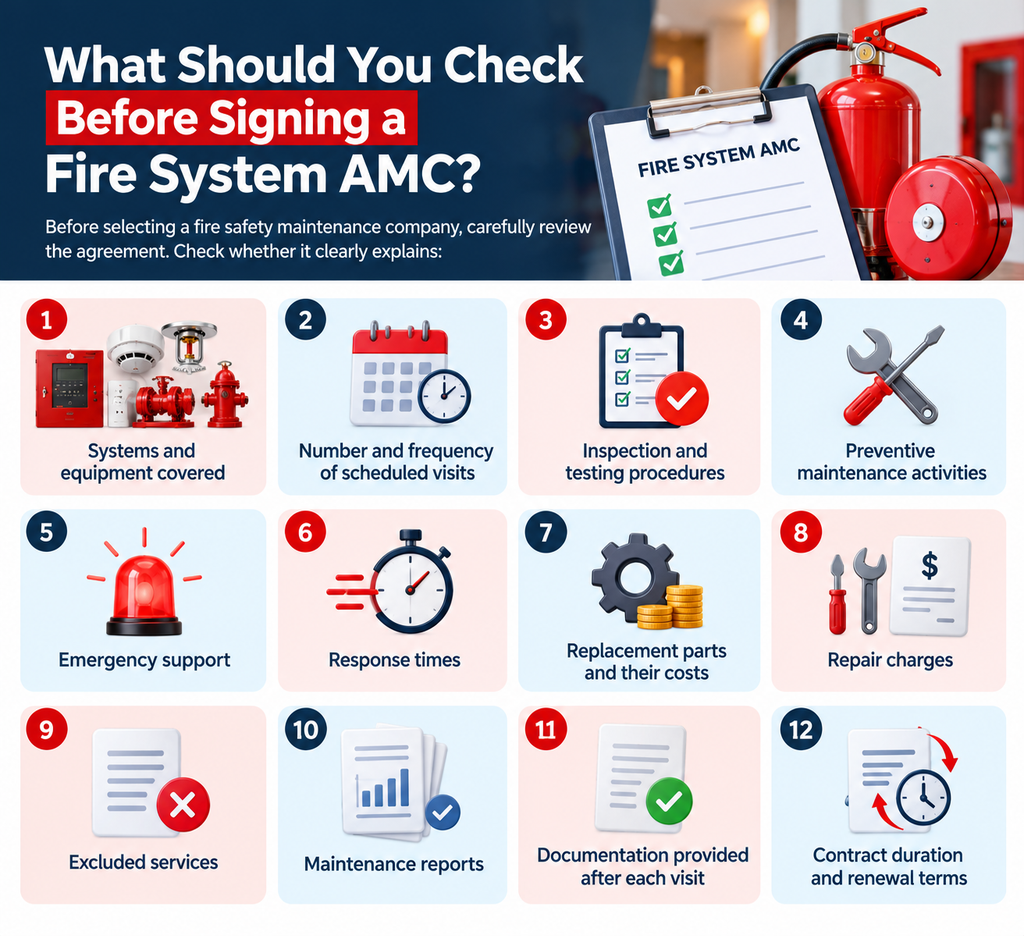
Before selecting a fire safety maintenance company, carefully review the agreement. Check whether it clearly explains:
- Systems and equipment covered
- Number and frequency of scheduled visits
- Inspection and testing procedures
- Preventive maintenance activities
- Emergency support
- Response times
- Replacement parts and their costs
- Repair charges
- Excluded services
- Maintenance reports
- Documentation provided after each visit
- Contract duration and renewal terms
A clear AMC prevents misunderstandings and helps building owners understand exactly what they are paying for.
Conclusion
The difference between a Fire System AMC and one-time maintenance comes down to the maintenance approach. One-time maintenance addresses a particular requirement, fault, or inspection, while an AMC provides an ongoing framework for scheduled preventive maintenance.
For buildings that depend on multiple fire protection systems, regular maintenance can provide a more structured way to keep equipment inspected, tested, and serviced. One-time maintenance remains useful for specific repairs and occasional requirements.
The most important factor is not simply choosing the cheapest maintenance option. Building owners should choose a maintenance approach that supports the reliability, safety, and operational needs of their fire protection systems.
For professional fire system maintenance and AMC services in Abu Dhabi and Al Ain, Fire Base Installation and Safety Equipments can support businesses with maintenance requirements for fire fighting systems, fire pumps, fire alarm systems, emergency and exit lighting systems, and related fire safety equipment.