
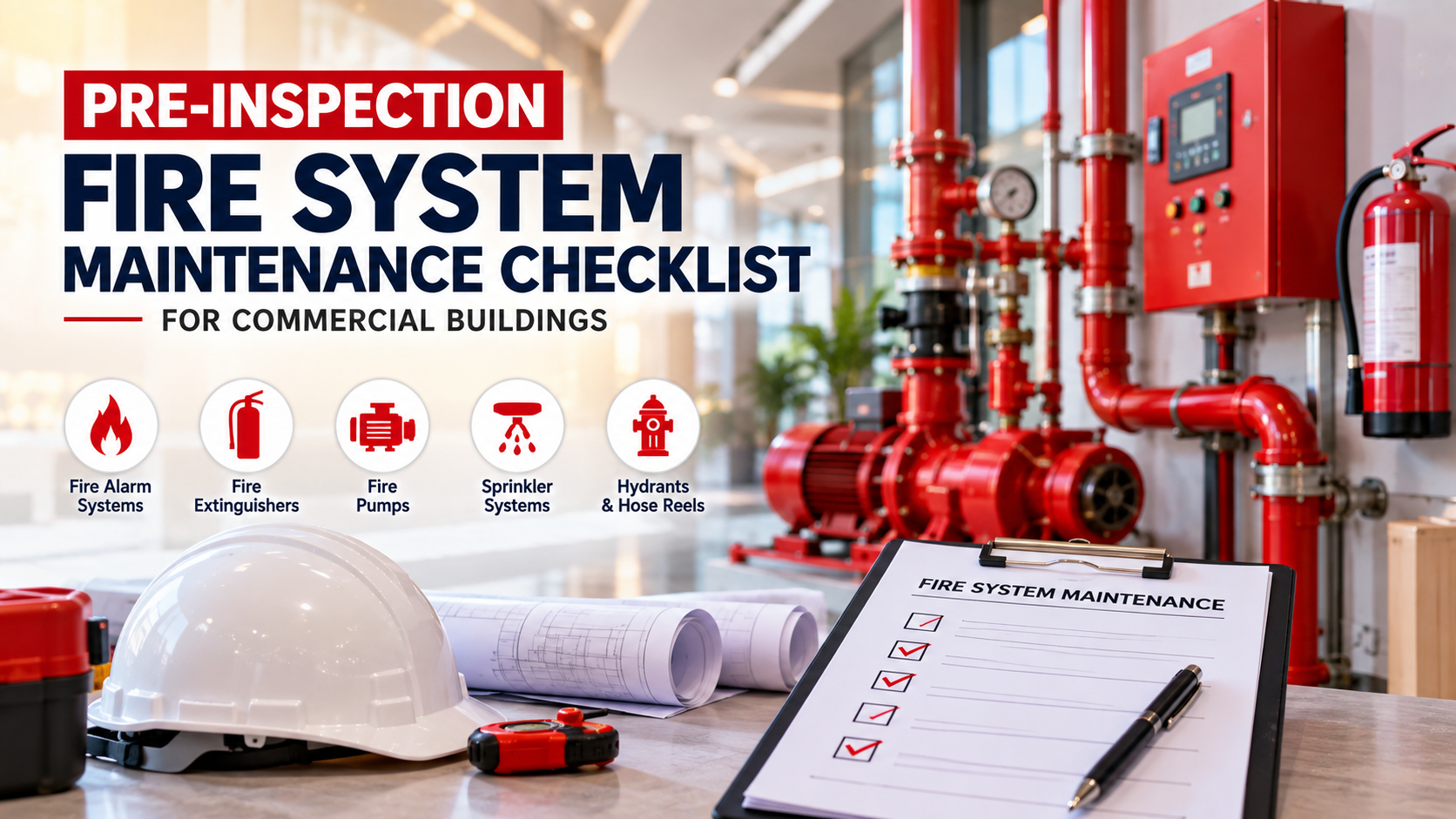
A fire protection company plays an important role in preparing commercial buildings for inspections and ensuring that fire safety systems remain operational. Before an official inspection, property owners and facility managers should complete a detailed maintenance review covering alarms, extinguishers, pumps, hydrants, sprinklers, emergency lighting and other critical equipment. Professional fire protection system servicing and regular fire equipment inspection can identify faults early and reduce the risk of system failure during an emergency.
Why Pre-Inspection Maintenance Matters
Commercial buildings often contain multiple interconnected fire protection systems. A problem with one component can affect the performance of the overall system. For example, a faulty detector may prevent an alarm from activating, while a malfunctioning fire pump can affect water supply to sprinklers or hydrants.
A pre-inspection maintenance check gives facility teams an opportunity to identify and address such issues before the inspection. It also helps maintain proper records and demonstrates that the building’s fire protection equipment receives regular attention.
A professional fire protection company can conduct a systematic assessment and recommend corrective maintenance where necessary.
1. Check the Fire Alarm System
The fire alarm system should be one of the first areas checked before an inspection. The maintenance team should review:
- Smoke and heat detectors
- Manual call points
- Fire alarm control panels
- Sounders and visual indicators
- Batteries and backup power
- Alarm monitoring connections
- System fault indicators
- Wiring and connections
The control panel should not display unresolved fault or trouble signals. Detectors and manual call points should also be tested according to the applicable maintenance procedure. Any damaged, disconnected or malfunctioning component should be documented and repaired by qualified technicians.
2. Inspect Fire Extinguishers
Fire extinguishers must remain accessible, visible and suitable for the risks present in each area.
During fire equipment inspection, check that:
- Extinguishers are correctly positioned
- Access is not blocked
- Safety pins and seals are intact
- Pressure indicators are within the appropriate range where applicable
- Cylinders show no visible damage or significant corrosion
- Labels and operating instructions remain readable
- Servicing information is up to date
Extinguishers that have been discharged, damaged or identified as requiring service should be handled by qualified personnel.
3. Inspect Fire Pumps
Fire pumps are critical components of many commercial fire protection systems. A pre-inspection check should include the pump room, pump controls, valves and associated equipment.
The maintenance team should verify that:
- The pump room is clean and accessible
- Pump controllers show normal operating status
- Valves are in their required positions
- There are no visible leaks
- Electrical connections are maintained appropriately
- Pressure readings are within the expected operating range
- Diesel pump fuel levels are adequate where applicable
- Batteries and chargers are in serviceable condition
Pump testing and servicing should follow the applicable system requirements and manufacturer’s recommendations.
4. Examine Fire Hydrants and Hose Reels
Fire hydrants and hose reels should be checked to ensure that they remain accessible and ready for use. Look for damaged hoses, blocked access, leaking valves, missing equipment or other visible problems. Cabinets should be clearly identifiable and should not be used for unrelated storage. Any issues identified during the inspection should be recorded and addressed before the formal inspection.
5. Check Sprinkler Systems
Sprinkler systems require regular maintenance because their components can be affected by corrosion, obstruction or accidental damage. A pre-inspection review should cover sprinkler heads, control valves, pipes, gauges and alarm components. Sprinkler heads should not be painted, obstructed or damaged. Storage arrangements should also be reviewed. Materials should not be positioned in a way that interferes with sprinkler discharge patterns or access to system components. Professional fire protection system servicing can help identify problems that may not be obvious during a basic visual inspection.
6. Review Emergency Exit Lights and Signage
Emergency lighting and exit signage support safe evacuation when normal power is unavailable.
Check that:
- Exit signs are visible
- Emergency lights operate correctly
- Escape routes are unobstructed
- Staircases remain accessible
- Exit doors can be used as intended
- Directional signs are properly positioned
Faulty emergency lights or damaged signs should be repaired or replaced promptly.
7. Inspect Fire Doors and Escape Routes
Fire doors help limit the movement of fire and smoke between different areas of a building. Check doors for visible damage, improper closing, damaged hardware and obstructions.
Fire escape routes should remain clear at all times. Do not allow equipment, cartons, furniture or other materials to block corridors, staircases or emergency exits.
8. Verify Maintenance Records
Documentation is an important part of pre-inspection preparation. Facility managers should organize records relating to previous inspections, maintenance activities, testing and repairs.
Keep available:
- Fire system maintenance reports
- Equipment inspection records
- Testing certificates where applicable
- Repair records
- Service reports
- Equipment lists
- Previous inspection observations
A qualified fire protection company can help maintain organized service documentation and identify outstanding maintenance requirements.
9. Address Outstanding Defects
Do not leave known faults until the inspection date. Review previous inspection reports and create a list of outstanding issues.
Prioritize defects that can affect the operation of critical fire protection systems. Once repairs are completed, document the corrective action and retain the relevant service records.
Working with an experienced fire protection company abu dhabi can help commercial property managers coordinate inspection, testing and maintenance activities.
Final Pre-Inspection Checklist
Before the inspection, facility managers should confirm that:
- Fire alarm systems have been checked
- Fire extinguishers are accessible and serviced
- Fire pumps are operational and maintained
- Hydrants and hose reels are accessible
- Sprinkler systems have been visually checked
- Emergency lighting is functional
- Fire exits and escape routes are clear
- Fire doors are in suitable condition
- Previous defects have been addressed
- Maintenance records are organized
Prepare Your Building Before the Inspection
A pre-inspection checklist should not be treated as a last-minute exercise. Regular maintenance helps keep fire protection systems prepared throughout the year rather than only before an inspection. From fire alarm systems and extinguishers to pumps, hydrants, sprinklers and emergency lighting, every component requires appropriate attention. Professional fire equipment inspection, scheduled fire protection system servicing and proper documentation can help commercial buildings maintain their fire safety systems effectively.
For businesses seeking professional support, an experienced fire protection company abu dhabi can assess existing systems, identify maintenance requirements and support ongoing fire protection management.